You fail to learn if you don't learn to fail
If all your time is spent watching output tokens, where do your input tokens come from?
Letting an agent rip on full auto is basically doom scrolling. Even worse if you're doom scrolling while the agent runs. We humans love frying our dopamine receptors. This feels great until you realize what you were offloading: the struggle. The part where you fail.
Failure is the entire point. You don't make progress in the gym unless you take a set at least close to failure. The muscle only adapts when it's forced to. It is no different for the brain.
Cognitive Atrophy
It is very hard to admit to yourself that your skills have atrophied. It is even harder to admit this to other people. I will admit that over the past several months my brain has gotten smoother (and I wasn't even on Twitter much!).
Recently, I had written an abstraction for my diff viewer (diffy), an element system with a macro that lets agents write html-like code in rust for native ui (they reason better with this). But it wasn't adopted everywhere in the repo yet, so when I asked for a new feature, the model decided to hand paint it straight to the viewport instead. Every behavior the element system gives you for free was just... missing. Text wasn't selectable. Hover highlights wouldn't go away. And since I wasn't looking closely, it iterated on the slop and produced more slop, more bugs. I just kept saying continue. I lost a whole day untangling it, and the funny part is that once I actually looked at what it had built, every bug was the same bug.
When you hit a roadblock and your immediate reaction is to reach for something else (previously, this used to be other people, but now it is a language model) you are essentially skipping the part where you actually learn to solve the problem.
It is funny how one of the best "learning tools" has turned out to be the number one cause (anecdotal. sue me) of the lack of learning!
It's been a few months since I started writing this, and things have gotten more dire. Several major software services barely work now, grown engineers I once respected are writing somber posts about missing a language model that was banned for a while. Mourning. For model weights. It's all so dystopian.
It didn't work, but boy was it beautiful.
As the agents get better, one is basically expected to produce code at an alarming rate. The timeline to get something done is compressed but the time it takes to come up with solutions to hard problems has not.
There are usually a few good abstractions one can come up with that balance the upsides and tradeoffs for most software problems. However it is currently trivial to turn your brain off and let the slop flow. The code will be complex. It might look like it all works, but something always breaks. And the solution to that? More slop. Software quality is collapsing as a result, and the societal expectation that engineers understand what they ship is disappearing. You never understood the code in the first place. So when you need to change it, you're asking the same stateless clanker to modify code it has no memory of writing. All output tokens and zero thinking tokens.
A lower barrier of entry to write software doesn't imply the standards for good software must be lowered.
The culture of doing things because they said you couldn't.
The growing trend is to do things because you now can (supposedly), but we used to try and do things because we could not out of sheer stubbornness.
Carmack and gang shipped QuakeWorld with client-side prediction over dial-up when the conventional wisdom was that twitch shooters over the internet were unplayable. This only happened because Quake's original netcode was laggy and everyone hated it. (They fixed it in a month.)
George Dantzig arrived late to class, mistook two "unsolvable" statistics problems for homework, and solved them. Nobody told him they were impossible, so he just did the work.
Andrew Wiles spent seven years alone in his attic working on Fermat's Last Theorem, a problem mathematicians had given up on for 350 years. He announced the proof, a reviewer found a hole in it, and he spent another year fixing that too.
Notice that all three of them became who they are because of the struggle, not despite it. The people benefiting most from generative tools today, say Terence Tao or Mitchell Hashimoto, already put in the time, so when they offload work they're just skipping the typing. When people like you and me (if this is not you, then I apologize) offload, we skip the grind itself. With language models, easy tasks got easier, hard tasks stayed hard. The hard part was never the task itself.
@codex how do I fix this
I don't know, I am figuring this out as I go. The amount of time I have spent actually programming has been dropping month over month this year. I used to have a coding stats section on my website that would track hours I spent writing code split by language, recently I had updated it to this:  and it made me quite sad.
I do think that sometimes all you need is to realize that the thing you are doing is actually detrimental to your growth. Consistency matters more than one would assume. If you consistently take some time away from these tools and actually use your brain, that alone is already significantly better than offloading your thoughts. Solve the problems yourself. Or at least try, fail, and spend time thinking.
There is seemingly no "learning" phase anymore. You are expected to just know things. Learning is fun, don't let anyone take this away from you. I've written about this before.
It is probably going to be slow, learning takes time and effort. You will feel stupid (I feel stupid). This is a good feeling, because there exists a world where you are no longer stupid and the path towards it is learning.
Books still exist! Libraries are still open, notebooks waiting to be written in. Read more. Write more.
But
If you really do care about improving yourself, be honest and use these models for what they are, highly efficient filters of zettabytes of data (the internet is estimated to be 175-240 zettabytes (
It was extremely difficult to identify what one needed to read to learn niche topics even like 2 years ago. I remember asking a good friend of mine to recommend material to dive deep into learning about SIMD, and honestly there wasn't much stuff to read except the Intel Intrinsics Guide. And if you've ever taken a look at that, it is quite cancerous for a first-time reader.
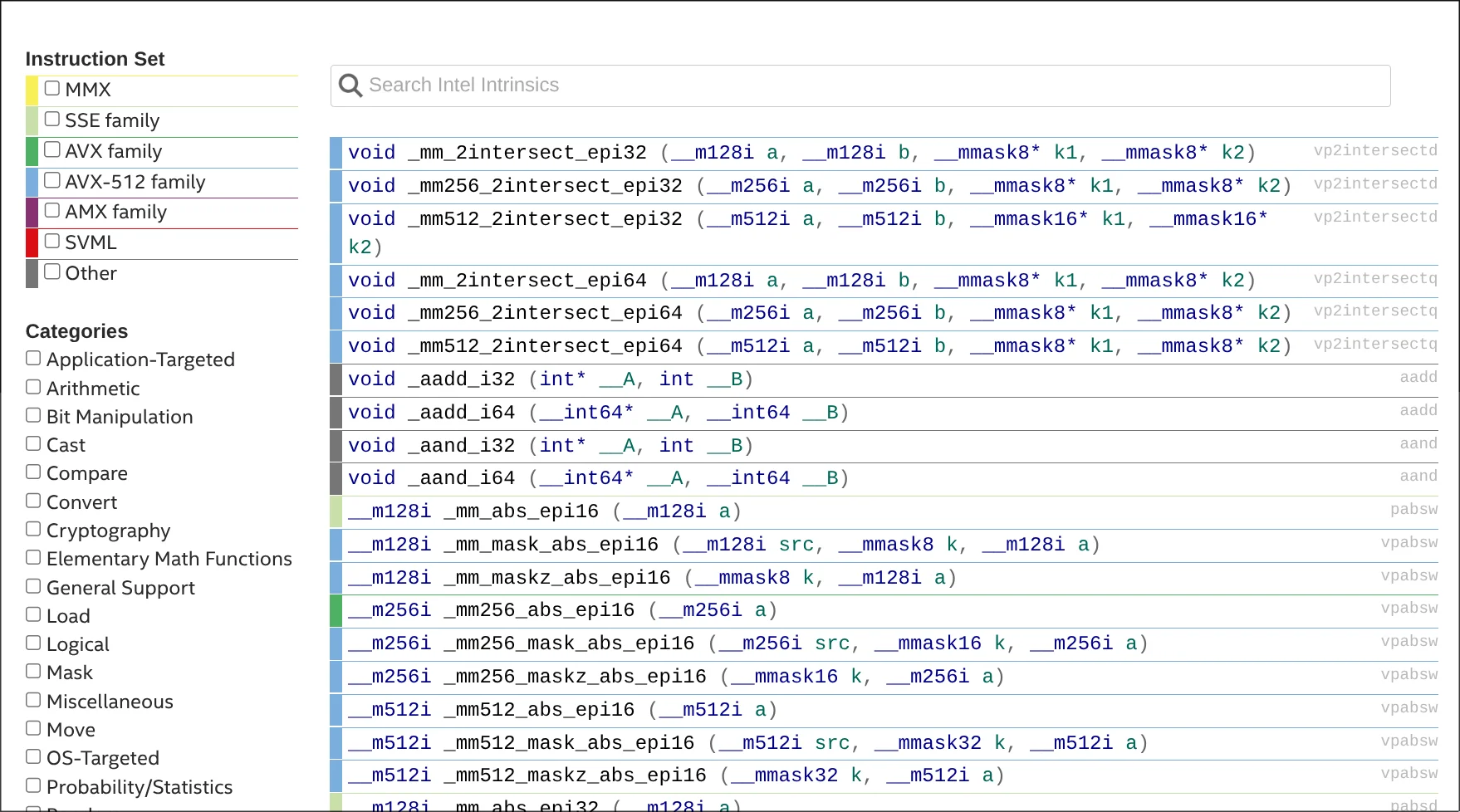
Language models are super useful here because you can point them at material and you can ask questions that pertain to the thing you care about and it will simply just tell you the correct things.
Conclusion
One good thing in this age of slop is to consume knowledge at an unbelievable pace. I don't necessarily mean using only model output for learning (I don't trust them to learn any topic more than a shallow amount), but rather using them to help sift through the plethora of information available out there and identifying the right things to read. Human slop exists too and using a language model to supplement your learning might help keep you sane (ironically).
I like using these models to write code that I tell it to write (outside of work I enjoy doing it myself entirely), and I am largely disinterested in asking it what I should write. There are exceptions of course, because not everyone is working on scaling software services which has largely been solved (but slowly being forgotten), but that would be for you to decide.
The best model you have access to (and it has solved continual learning) is, and always has been, the one inside your skull. It's time to scale up its input tokens.